


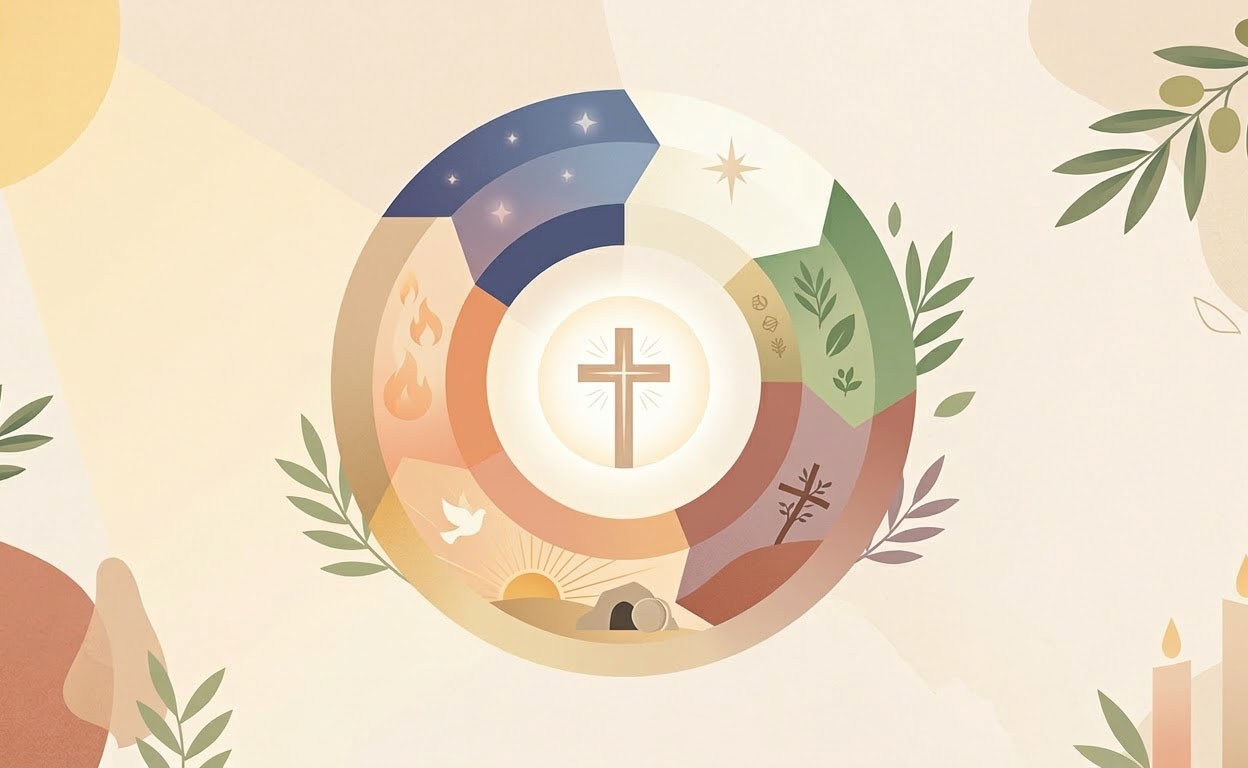
The Liturgical Year
The Holy Mother Church sees fit to celebrate the saving work of her divine Spouse in a sacred cycle of seasons, feasts, and commemorations. In the course of a year, she unfolds the entire mystery of Christ, from the Incarnation and Nativity to the Ascension, to Pentecost, and to the awaiting of the blessed hope and coming of the Lord.
Advent
The Liturgical Year begins with Advent, a season of devout and joyful expectation. For four weeks, the Church prepares her children to celebrate the Nativity of our Lord Jesus Christ and to make their souls a worthy abode for the Redeemer. The spirit of this time is one of penance, prayer, and longing for the coming of the Saviour, both in His first coming in humility and His second coming in glory. The liturgical colour is violet.
Christmastide
Following Advent, the Church bursts forth in jubilation with the season of Christmas. It begins with the Solemnity of the Nativity of the Lord and extends to the feast of the Baptism of the Lord. This is a time of profound joy and thanksgiving for the mystery of the Incarnation, wherein the Word was made flesh and dwelt among us. The liturgical colour is white, signifying joy and purity.
Time after Epiphany (Ordinary Time)
After the splendours of Christmastide, the Church enters the season known as the Time after Epiphany, which leads to the beginning of Lent. During these weeks, the liturgy directs our minds to the public life of Our Lord, His teachings, and His miracles, revealing His divinity to the world. The liturgical colour is green, a symbol of hope and the growth of the soul in faith.
Lent
The holy season of Lent is a period of forty days of penance, prayer, and fasting in preparation for the great feast of Easter. It begins on Ash Wednesday and concludes on Holy Thursday. It is a time for mortification and conversion of heart, wherein the faithful unite their small sacrifices to the great sacrifice of Christ on the Cross. The liturgical colour is violet, a sign of penance.
The Paschal Triduum
These are the three most sacred days of the entire Liturgical Year: Holy Thursday, Good Friday, and Holy Saturday. On Holy Thursday, we commemorate the institution of the Holy Eucharist and the Priesthood. On Good Friday, we meditate upon the Passion and Death of our Saviour. On Holy Saturday, the Church waits at the Lord’s tomb in prayer and fasting, until the solemn Easter Vigil ushers in the joy of the Resurrection.
Eastertide
Easter is the greatest feast of the Christian year. The season of Eastertide lasts for fifty days, from Easter Sunday to Pentecost Sunday. It is a prolonged celebration of Our Lord’s glorious Resurrection from the dead, His victory over sin and death. The Church is filled with an exultant joy, frequently chanting the Alleluia. The liturgical colour is white, and on Pentecost, red, for the fire of the Holy Ghost.
Time after Pentecost (Ordinary Time)
After the descent of the Holy Ghost at Pentecost, the Church enters the longest season of the Liturgical Year, the Time after Pentecost. This season continues until the beginning of Advent. During these months, the Church, guided by the Holy Ghost, leads the faithful to live out the mysteries of Christ in their daily lives. The readings and prayers focus on the growth of the Kingdom of God on earth. The liturgical colour is green, representing the life of grace and the hope of eternal life.
Contexte Historique
The Liturgical Year, or Christian Year, is the annual cycle of seasons and feasts observed in the Catholic Church. Its structure developed organically from the earliest days of Christianity. Initially, the Church’s worship was centered on Sunday, the weekly commemoration of the Resurrection. This was soon expanded to an annual celebration of the Paschal Mystery at Easter. Over the centuries, other feasts commemorating events in the life of Christ, the Blessed Virgin Mary, and the saints were added, creating a rich tapestry that allows the faithful to journey through the entire mystery of salvation each year.